An art of attention: listening to everything
Let us start by turning away from the screen and trying an exercise with our fingers. Pick up an imaginary stringed instrument, imagine it is a medieval lute, hold it, feel its wood, imagine its taut strings. Now imagine you can play this beautiful instrument and try to strum the strings mimicking the gestures of »an emaciated crow pecking at the snow in hope of finding something to eat.« If this is too hard, try this time to imitate »the nonchalant flick of a carp's tail« with your fingers.
Was it easy?
These strangely beautiful instructions are from The Great Treatise on Supreme Sound,3 a 14th-century handbook for musicians. It taught lute players specific gestures, like a staccato pluck, by suggesting they copy the movements of animals, the assumption being that it would be totally normal for a musician to have not only seen these animals’ behaviour up close, but spent enough time giving them the deep attention needed to be able to reproduce and embody their gestures.
When was the last time you watched a wild animal coexisting with its habitat?
When was the last time you gave some attention to living beings and bodies that were not human, or rather as ecologist, philosopher, and sleight of hand magician David Abram says, more-than-human?4
Now 700 years later, most of you reading this will be living in the metropolis and probably only experience wild animals on your screens or in cages in zoos. In the metropolis, everything is done so that humans only relate to themselves, so that we create ourselves separately from other forms of existence, other forms of life. This human centred logic, this deep separation, is embodied and naturalised in the very fabric of the metropolis: in the concrete and tarmac, powerlines and fiberoptics, in the layout of streets, the networks of surveillance cameras, the architecture of shopping malls, the design of parks, the museum districts – all capturing our body-minds and behaviours 24/7. The metropolis is what you have when the modernisation process is complete and »nature« is gone for good, where only »we« produce and create reality. And that reality is shaped by the urbanists and architects, the planners and managers, the executives and bureaucrats, in the likeness of the »sky’s the limit« gods of economic growth. Development and productivity become the only goal.
It's a world without worlds, where we are split from our food sources, from our soil, from our plants and our water. The worlds that sustain our life have become alien, like unknown planets. We have forgotten how to make our shelter, which plants can heal us and which feed us, how to clothe ourselves, what the seasons are, where the wind blows from, to recognise the song of the birds returning at spring time, to know how to find our way home using the north star.
As I finish writing that sentence, I hear the hoot of a brown owl sitting on the oak tree whose branches caress the caravan from which I’m writing. Our home is on a wetland, the ZAD: Zone à Defendre (Zone to Defend) of Notre-Dame-des-Landes, where the French government and multinational company Vinci once wanted to put an international airport, stretching the grey urban fabric into these fields and forests. But thanks to decades of creative disobedient bodies, including our own, these lands were saved from being sucked dry and covered in concrete. New forms of collective life were built in the way of the developers: beautiful cabins grew out of the mud, farms flourished, pirate radio station emitted, bread was baked for hundreds of inhabitants, a rap studio welcomed anyone to write and record, medicinal herb gardens healed us, traditional call and response folk songs are hacked to retell stories of the struggle, and at the centre of the zone we built a full scale working lighthouse exactly where the control tower should have been, topped with a huge siren to alert the zone if there were evictions. The tabloid-like 24-hour French news channel BFMTV even called the ZAD »a utopia that might be being realised!«
I’ve always wanted to find a way where art and life, nature and culture, resistance and creation are entangled, and I found it on the ZAD. Here art becomes a discipline of attention, a reciprocal attitude, enfolded into the designs of our everyday lives, our ways of resisting and partying, the way we build our houses and the layout of our gardens, the ways we organise rituals to mark the seasons, the way we care for the commons. It is a life that is consciously crafted, rather than another style of art. We need »a technique of life, an art of living. We have to create ourselves as a work of art,« claimed philosopher-activist Michel Foucault. »Rather than something specialized or done by experts, couldn’t everyone’s life become a work of art?« he asked. »Why should the lamp or the house be an art object, but not our life?«6
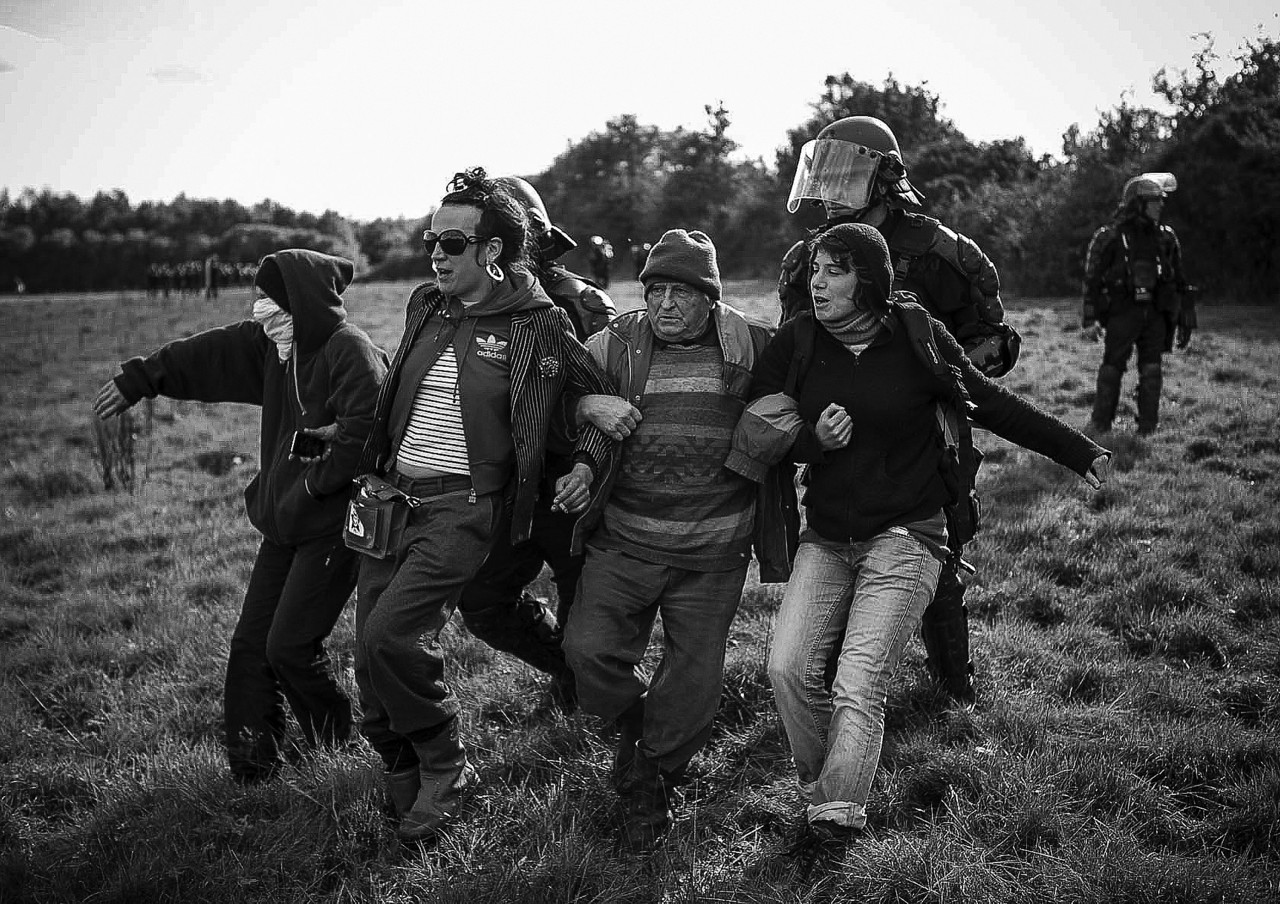
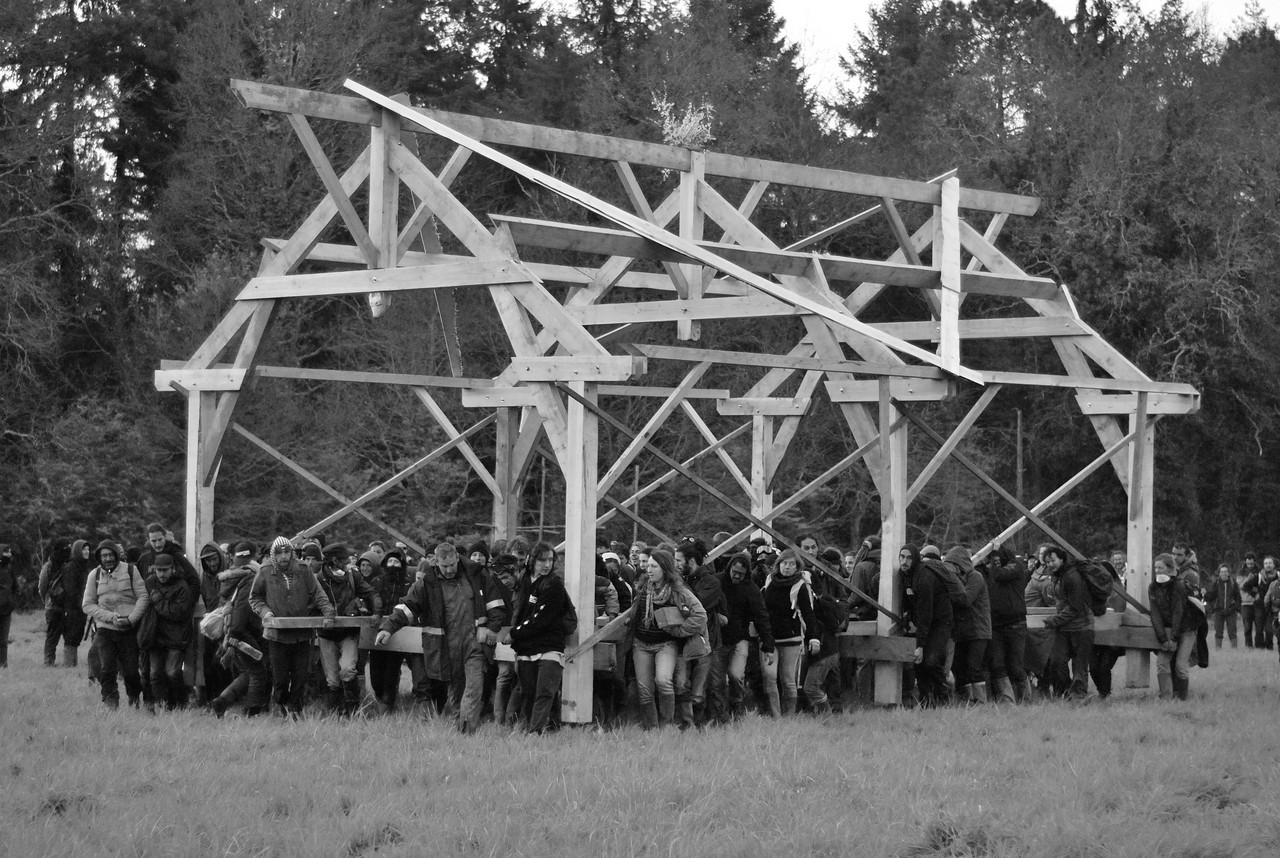
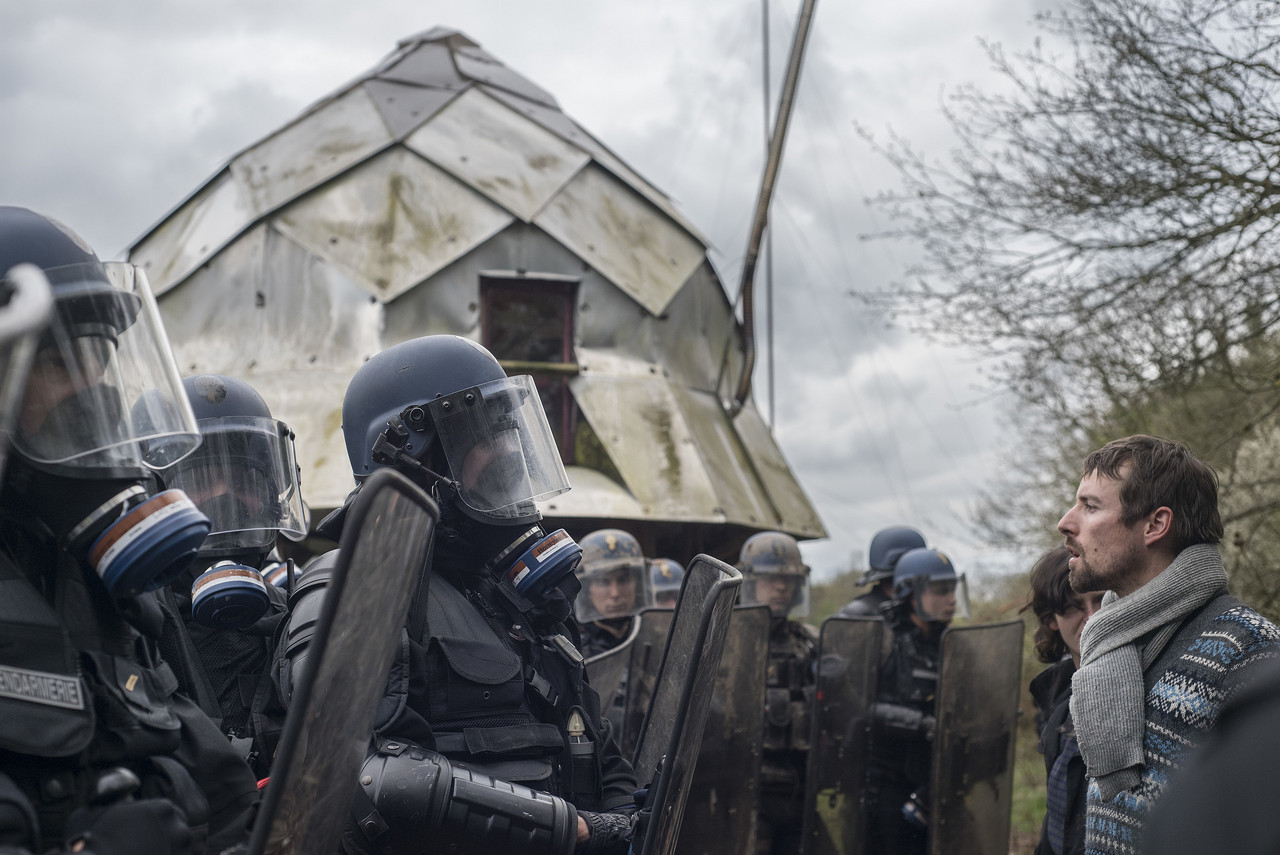
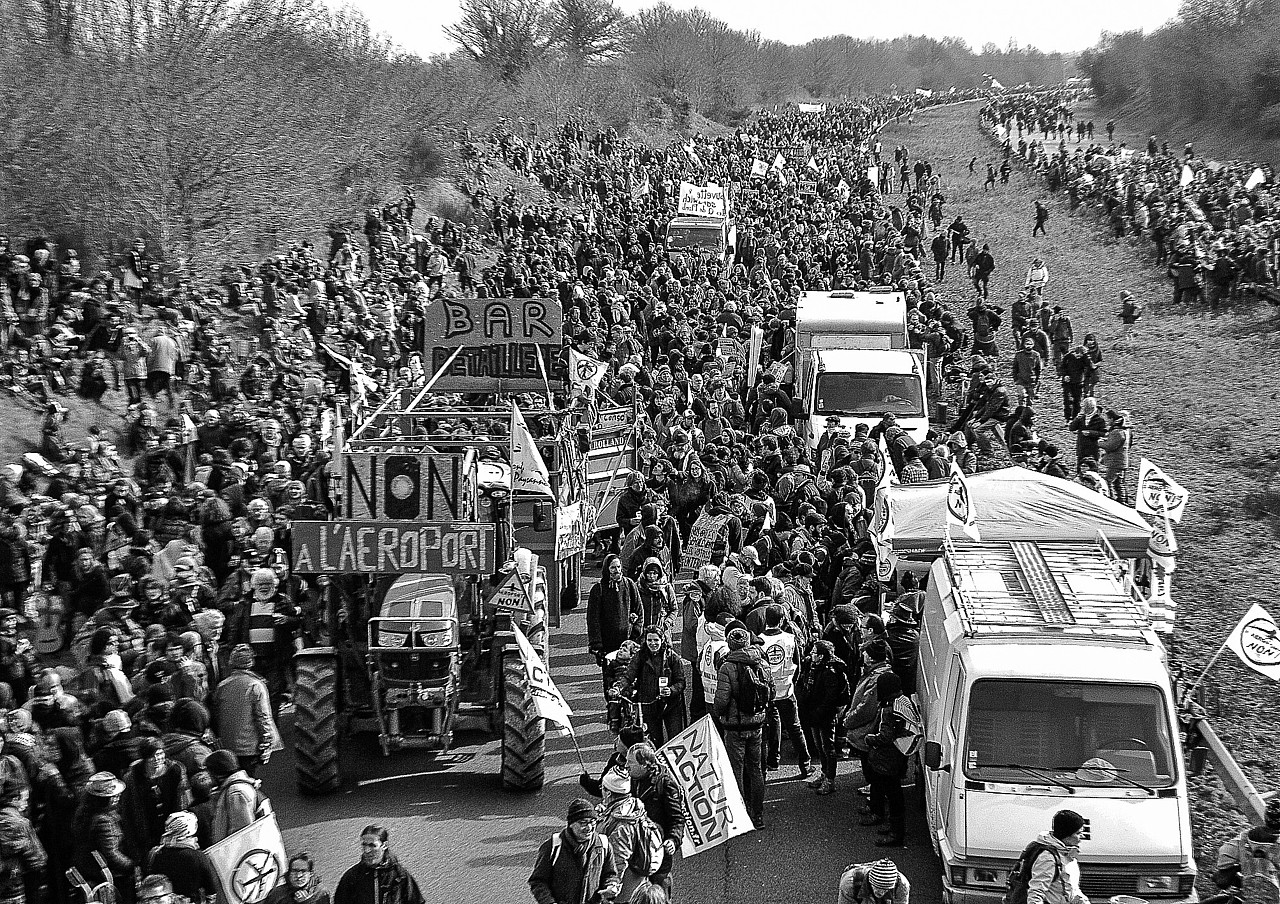
But one of the most important reasons we were able to protect these lands was because we got to know the hedgerows and greenways, the forest and marshlands, the prairies and streams, when the newts mate and the swallows return from Africa, we got to know these lands in the same profound way a dancer knows his body or an acrobat senses her muscles.
When you pay attention to something it becomes sacred. Nothing is created sacred, it's the attention we give to it that renders it so. I don’t mean sacred as holy almighty aloof power, but, as my friend Starhawk (an incredible witch and activist) taught us: immanent sacredness »is not a great something that you bow down to, but what determines your values, what you would take a stand for.« When something is sacred it becomes harder to destroy, to pollute, to turn into a resource, and you are prepared to put your life into protecting it. The more you inhabit a territory the more it inhabits you.
The owl hoots again, and I’m reminded of the incredibly courageous 19th century abolitionist Harriet Tubman, who used her knowledge of birdsong and of the living world to save so many lives. Tubman escaped from slavery aged 27 and rescued hundreds of escaping slaves by guiding them up what was known as the Underground Railroad, a network of safe houses ferrying slaves to safe haven. She mastered these long dangerous journeys through marshlands and forest, often tracked by dogs sent out by the authorities to sniff them out. She had grown up in the wetlands and had a complex understanding of the landscape, and she would use the call of barred owls to alert the refugees as to whether or not it was safe to come out of hiding and continue their journey. Her accurate rendition of the sound of the bird blended in with the normal night time sounds, and created no suspicion. The lives of the freedom seekers were saved.
This is the art of attention, observing and sensing the living world deeply, feeling its pleasures and pains and performing forms of life that open up spaces so that the life of others can continue to thrive. A slave is freed, a wetland continues to flourish.
Desert Nero culture
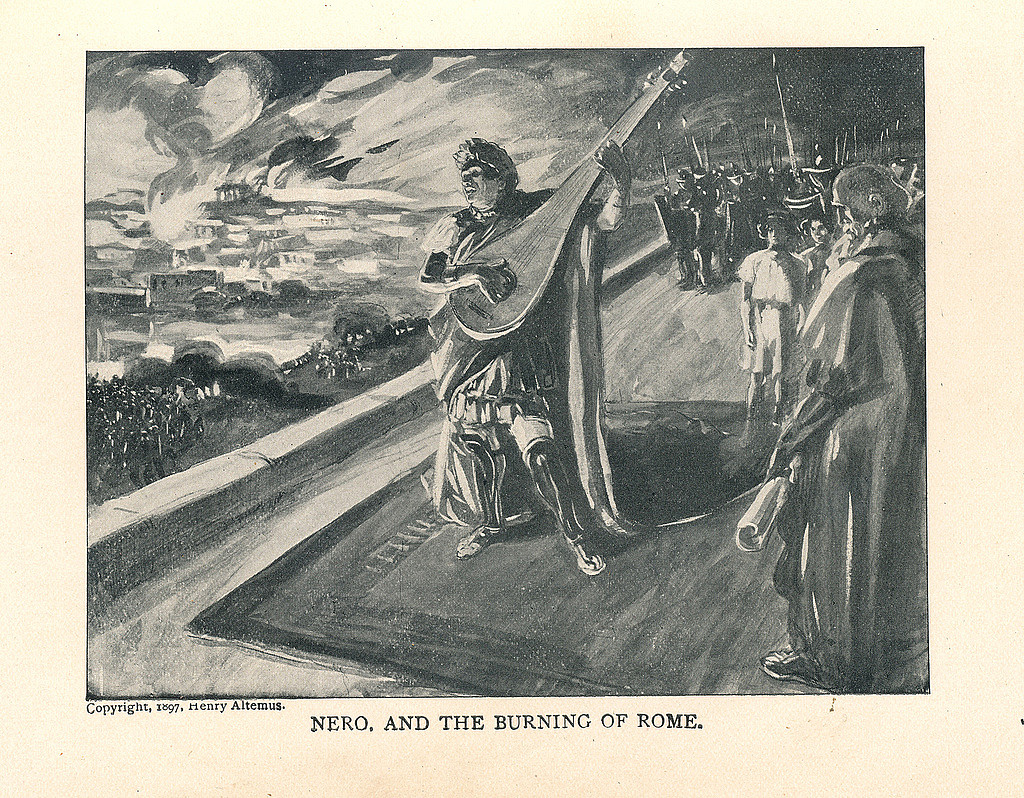
The Roman Emperor Nero did not play the lute, but the lyre. The myth claims he played music whilst watching the city of Rome burn. This story was a metaphor for cold, ruthless, tyrannical leaders without feelings, able to watch a disaster from their lofty positions of power and caring nothing for those suffering – not unlike former US president Trump who played golf whilst the bodies of the poor and the elderly dying of Covid-19 piled up across the US.
For me, this myth has more sense now than it ever did. But Nero does not represent an individual any more, but our entire Western idea of art and culture, a culture that – until Covid-19 lockdowns – continued business as usual despite living in a world on fire. Despite 200 species pushed to extinction every day, despite soils turning to deserts, despite poverty rising faster than the seas, despite a tsunami of mental health issues paralysing young people, despite the far right spreading faster than the forest fires – our culture continues its escape into the same old forms of entertainment. The Roman Empire collapsed partly due to ecological overstretch, but also because of its strategy of bread and circuses, today more alive than ever: keeping the people docile through diversion and distraction never failed.
No artist, no activist, in fact, no human being, nor any of the more-than-human species who live inside and outside of us, has ever been faced with such crises before. A recent official European Commission policy paper ended with the analysis that if the planet sees beyond 1.5°C of warming, »we will face even more droughts, floods, extreme heat and poverty for hundreds of millions of people; the likely demise of the most vulnerable populations—and at worst, the extinction of humankind altogether.«10 We are all living within a world where it is now easier to imagine the collapse of all life than imagine reinventing the right ways to live.
And as known worlds collapse, so do our ways of thinking and understanding. Donna Haraway writes that in the laboratories of social and natural sciences, »human exceptionalism and bounded individualism, those old saws of Western Philosophy and political economics, become unthinkable.«11 Scientists are showing us that the idea of »nature« as unfeeling machines outside of us is an illusion, and that we all – from the whale to the cell – feel and sense the world, we all share a hunger for life that drives us to create, we all share an inwardness, a felt subjectivity.
But in the concert halls and theatres, museums and studios, galleries and festivals of the metropolis, it seems that even though this era has made the arts as we knew them unthinkable too, so many continue, business as usual. The catastrophe may well have been integrated as a topic;there is constant inventiveness in art's material forms, but its essence has not been reinvented. This is partly because the arts as we know them are still very much conceived of as a universal defining feature of civilisation. Yet according to art historian Larry Shiner, the arts as we knew them are »a European invention barely two hundred years old«.12 For most of human history and for most of human cultures there was no word to describe the arts as we knew them today. Then something unprecedented happened, what some have called a Copernican revolution in art. It started around 1750, in the white colonial metropolises of Europe, at the very onset of another revolution – the industrial capitalist one. For the first time, the process of making things became independent of human or animal power, of seasons, of weather, wind, water, and sun rays. Making became independent of place as the fossil fuel burning machines of the capitalocene, first coal then oil, amplified the logic of extractivism and our life support system began to be plundered everywhere.
As the capitalocene began to ravage our worlds, traditional ways of thinking and making art were split apart, and the arts as we knew them became the new normal. What was once the process of inventive collaboration became the creation of individual genius, works that once had a specific purpose and place were separated from their functional contexts and enclosed for silent and reverential contemplation by the rising middle classes. If you had visited a city or village before the 1700s, there were no concert halls, the idea of music as something to watch on a stage – that was not situated in a particular time or place, nor contextualised by a ritual or seasonal festival – did not exist. Music was entangled with life. This new notion of a contemplative universal art – no longer situated nor useful, with its silent polite audience – was pushed worldwide by missionaries, armies, entrepreneurs, dealers, and intellectuals as one of the engines of progress. It colonised imaginations everywhere and continues to do so. Without the violent rift that it created between artists and artisans, genius and skill, the beautiful and the useful, art and life, the system of the arts as we knew them, that most of us reading this text work in and depend on, would collapse.
And yet it seems so obvious that in this crisis, it is exactly these rifts that must be healed and an extractivist art – art which takes value from specific places and regurgitates it elsewhere, from the past to the present, from this messy life to a slick show somewhere else, from this community to my career – has to stop. Today any look around the arts as we knew them system will show its vampire-like tendencies, sucking value out of collapse, rebellion, migrant struggles, ecology, territorialisation, magic, new-materialism – whatever is a fashionable topic at the time, and regurgitating it into un-situated detached objects, performances or experience elsewhere, anywhere in fact, as long as it is a context where the codes of the arts as we knew them system function, be it the metropolitan concert hall or street, nightclubs, the museum, or neighbourhood park.
The concerts and performances, the interventions and installations of extractivist art all »speak about,« »comment on,« or »explore« their subjects; they »invite us to spur a debate« or a »conversation.« they attempt to make things beautiful and/or strange, they want to move us, »make visible« an invisible problem or invite a polemic. An album is released about mass extinctions and the band tour the world in climate burning airplanes, a new song about spreading deserts hits the charts on Spotify whose servers are part of the data centers now producing 2% of greenhouse gas emissions,16 a DJ plays a set for the launch of an exhibition on activist art in a museum sponsored by a fossil fuel funding bank. Often the artist is deeply »concerned« by the issue, and the communities affected by it routinely become their material. But in the end, the most important thing is not how the work can be part of a strategy against the problem, but that the material is extracted and transformed into good art. Their relationship with life is that of a resource rather than that of reciprocity. The work does not really »give back« despite all its claims, what benefits most is the artist’s career and the further legitimisation of the institutions promoting arts as we knew them. Whether the work nourishes and sustains the social movements or communities invested in these issues is hardly ever on the agenda. Asking whether the work is useful or contributes in any way as some material solution to the issues it »deals with« is virtually a heresy, leading to accusations of instrumentalisation. If the art is used by political movements, it loses its fantasy of autonomy!
In this extraordinary moment, this crack in the system that is the pandemic-world, where the line between what seemed unfeasible and what ended up being possible has been smudged, where so few of us want to return to the toxic normal, perhaps we can take the risk of reinventing this worn out invention of art. Perhaps we can begin shifting it away from the logic of extractivism, and towards reciprocity.
As musicians and sound makers what could that look like? How could you apply your creative imagination to movements that are trying to block the catastrophe and create new forms of life? Could we write tracks to be played on sound systems that become barricades to stop buses deporting migrants? Could sound be used to disorient the police when they attack demonstrations? How can sound be used to heal activists suffering from trauma? Can sonic works sabotage the gentrification of city neighbourhoods? Can music be used to pass secret messages between banned activists? Can we make music that sends us into ritual trance to celebrate the return of spring and connect us with the flourishing of life? There are so many possibilities to put sound and music back in the service of life and struggle, rather than continue its role as entertainment or spectacle for the collapse of life.
In the late 18th century, just as the invention of art was emerging in colonial Europe, the Maroons in Jamaica were fighting the British colonising army that violently attacked (and lead to the eventual collapse of) their tribal life. One way they outwitted the empire was with the use of drums and calls from the abeng, a fashioned cow horn.17 Using secret code signs, they communicated between villages with abeng signals to warn of the army’s approach, how much weaponry they carried, and where they were arriving from. They would also use the horns, with their dislocated tones, to scare the British and often repel the invaders. But their greatest weapon against empire was camouflage. They were brilliant at it because they had paid attention to their territory so well: “[t]hey embedded themselves in leaves and vines and melted into the surrounding bushes,” writes British-Ghanaian artist theorist Kodwo Eshun. »The British repeatedly walked into clearings where their surroundings would suddenly come alive and close in on them.«18
Life’s wonder
I feel the warmth of the spring sun on my fingers as I tap these words. Through the window, the black thorn bushes in the hedgerows have burst into clouds of little white flowers. Soon I will see the tiny warbler (whose French name, Polyglotte Hippolais, means the »many tongued harmonious one«) return from Africa, sit on the crooked blackthorn branches, and sing its song that resembles a merger of 90s modem sounds and lo-fi effects from vintage video games. No bigger than my fist, it is able to imitate dozens of other birds. It replays samples from species in Europe and Africa, where it winters, into wild mixes. Our civilisation used to say this beautiful song was just an advertising jingle, a souless soundtrack saying »come fuck me« or »fuck off,« just another sonic weapon in the battle of biological survival and efficiency. They imagined birds like machines just obeying the dictatorship of DNA; only humans could have souls and selves, only we could express emotions.
But if the warbler is able to imitate other species, then this mirroring, representing, and arranging in replay suggests to ethnologists that the bird's behaviour has the ability of abstraction. It experiences that there is self and world and perceives that it can act on this world according to a personal point view, a sensitive inwardness, a sensing self. Its song isn't a deterministic sequence of cause and effect, but an individual self freely expressing and celebrating its feelings of aliveness.
The civilisational shift that we are living through gorgeously muddles and complexifies every binary: perhaps nature is after all no different from culture, it too is the form that emerges from feeling. »If feeling is a physical force and the expression of this feeling is a physical reality whose meaning motivates organisms to act,« writes biologist Andreas Weber, »then we might understand living beings better if we imagine what is happening in the biosphere as, in a way, resembling artistic expression…Art then is no longer what separates humans from nature, but rather it is life’s voice fully in us. Its message is that beauty has no function. It is rather the essence of reality.«20
It is hard to imagine reality in the world of the writer who composed those instructions for playing the lute, written 700 years ago, that we began this essay with. But it is perhaps even harder to imagine what our descendants might think when they look back at our period in history in 700 years time. If Homo sapiens haven't joined the extinction list by then, will they tell stories about a paradigm shift more profound than the Neolithic or Industrial revolutions, when culture turned towards life again and in so doing healed art, and put it back together? Perhaps they will sing songs about the artists that deserted the extinction and representation machines, dissolving back into life to become real Thaumataurges at last – those that reveal the wonders of life.
- 1
Bennett, Jane. Vibrant Matter: A Political Ecology of Things, Duke University Press, 2009.
- 2
Abram, David, The Spell of the Sensuous, Vintage Books, 1996.
- 3
Bennett, Jane. Vibrant Matter: A Political Ecology of Things, Duke University Press, 2009.
- 4
Abram, David, The Spell of the Sensuous, Vintage Books, 1996.
- 5
Rabinow, Paul ed. The Foucault Reader (New York, Pantheon Books, 1984), 350.
- 6
Rabinow, Paul ed. The Foucault Reader (New York, Pantheon Books, 1984), 350.
- 7
European Strategy and Analysis System, “Global Trends to 2030: Challenges and Choices for Europe,” 2019.
- 8
Haraway Donna,, Staying With the Trouble, Duke University Press, 2016. 30.
- 9
Shiner, Larry, The Invention of Art. A Cultural History, University of Chicago Press, 2001. 3.
- 10
European Strategy and Analysis System, “Global Trends to 2030: Challenges and Choices for Europe,” 2019.
- 11
Haraway Donna,, Staying With the Trouble, Duke University Press, 2016. 30.
- 12
Shiner, Larry, The Invention of Art. A Cultural History, University of Chicago Press, 2001. 3.
- 13
Blistein, Jon, “Is Streaming Music Dangerous to the Environment? One Researcher Is Sounding the Alarm,” Rolling Stone, 2019.
- 14
Goodman Steve, Sonic Warfare: sound, affect, and the ecology of fear. MIT Press, 2012.
- 15
Eshun, Kodwo, “Further Considerations on Afrofuturism”, CR: The New Centennial Review 3, no.2, Summer 2003), 289.
- 16
Blistein, Jon, “Is Streaming Music Dangerous to the Environment? One Researcher Is Sounding the Alarm,” Rolling Stone, 2019.
- 17
Goodman Steve, Sonic Warfare: sound, affect, and the ecology of fear. MIT Press, 2012.
- 18
Eshun, Kodwo, “Further Considerations on Afrofuturism”, CR: The New Centennial Review 3, no.2, Summer 2003), 289.
- 19
Weber, Andreas, The Biology of Wonder: Aliveness, Feeling, and the Metamorphosis of Science, New Society Publishers, 2016. 195.
- 20
Weber, Andreas, The Biology of Wonder: Aliveness, Feeling, and the Metamorphosis of Science, New Society Publishers, 2016. 195.